
API petroleum tubing
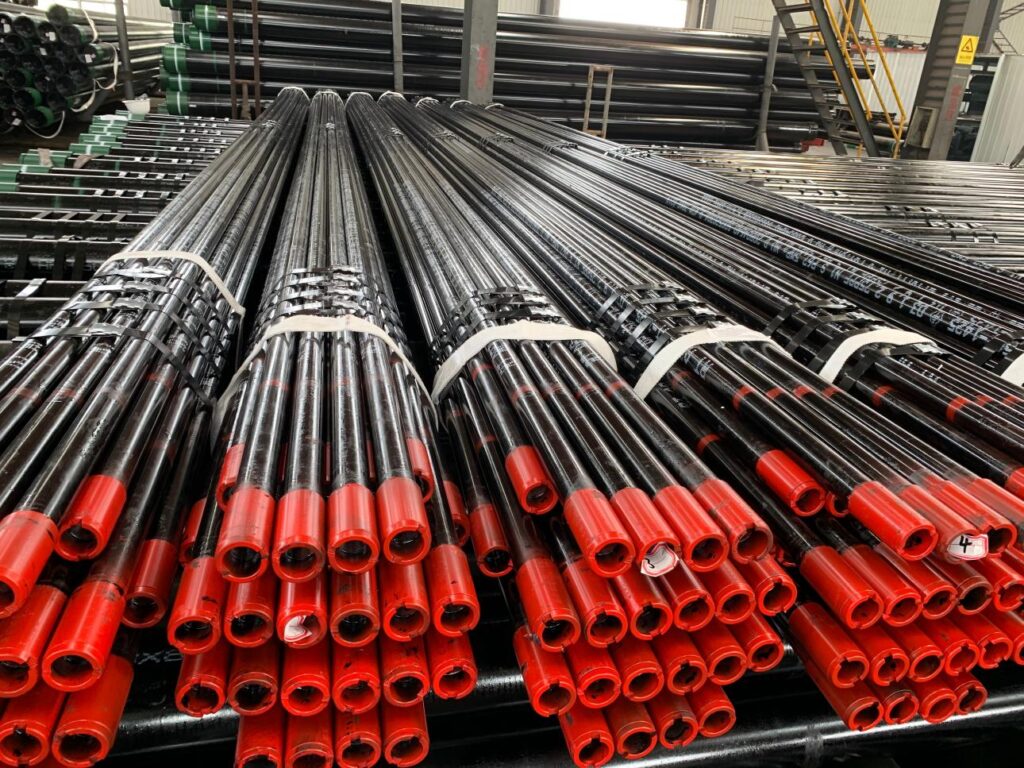
Petroleum tubing is divided into flat tubing (NU), thickened tubing (EU), and integral joint tubing (IJ). Flat oil pipe refers to a pipe end that is threaded directly without thickening and equipped with a coupling. Thickened oil pipe refers to the process of externally thickening both ends, threading and attaching clamps. The integral joint oil pipe refers to one end passing through an internally thickened external thread and the other end passing through an externally thickened internal thread, directly connected without a coupling.
The function of oil tubing:
- Extraction of oil and gas: After the oil and gas well is completed and cemented, oil pipes are placed in the reservoir casing to extract oil and gas to the surface.
- Water injection: When the downhole pressure is insufficient, water is injected into the well through tubing.
- Steam injection: During the thermal recovery process of heavy oil, insulated tubing is used to inject steam into the wellbore.
- Acidification and fracturing: In order to increase the production of oil and gas wells in the later stage of drilling, it is necessary to input acidification and fracturing media or solidified materials into the oil and gas reservoir, which are transported through oil pipes.
Product Specifications:
- Specification range: Outer diameter: 42.16 MM-114.3 MM (1.66 “–4 1/2”) Wall thickness: 3.56-16mm (2.3ppf-26.1ppf)
- Material: H40, J55, K55, N80-1, N80-Q, L80-1, L80-9Cr, L80-13Cr, P110, Q125, etc
- Execution standards: API 5CT, GB, ISO11960, GOST
- Type of buckle: NU, EU, IJ
- Length: R1, R2, R3
- Testing: NDT and other related rules of API 5CT and 5B
- Type: Seamless steel pipe